
Why PETcovery?
The need for the PETcovery project arises from the significant challenges associated with polyester recycling in textile circularity and PET plastic packaging. Polyester is the most widely used textile fibre globally, with a market share of 54 %, and it has the highest greenhouse gas impact among all fibres. The separate collection of textile waste has started in Finland in 2023 and was implemented across all EU member states by January 2025. Additionally, packaging constitutes more than 97 % of the 5 million tonnes of PET products placed on the EU market annually. Novel recycling solutions for PET plastic packaging are essential to increase circularity and address the environmental impact of these materials.
Technical approach
The project proposes a chemical recycling method via glycolysis, utilizing novel catalysts to enhance the economic viability and efficiency of the process.

The technical approach involves use of the novel catalysts for the depolymerization of most common polyester, polyethylene terephthalate (PET). It enables achieving lower process temperatures and faster reactions with higher yields compared to traditional methods. The scope includes increasing the technology readiness level (TRL) of the process and also tackling the challenges related to polyester waste feedstock and conducting techno-economic and environmental evaluations. To support exploitation and commercialization, the results will be protected under intellectual property rights (IPR) whenever it is possible.
Project structure
The project is structured into five work packages:
- WP1 Feedstock examination
- WP2 Depolymerization
- WP3 Repolymerization
- WP4 Process evaluation
- WP5 Exploitation
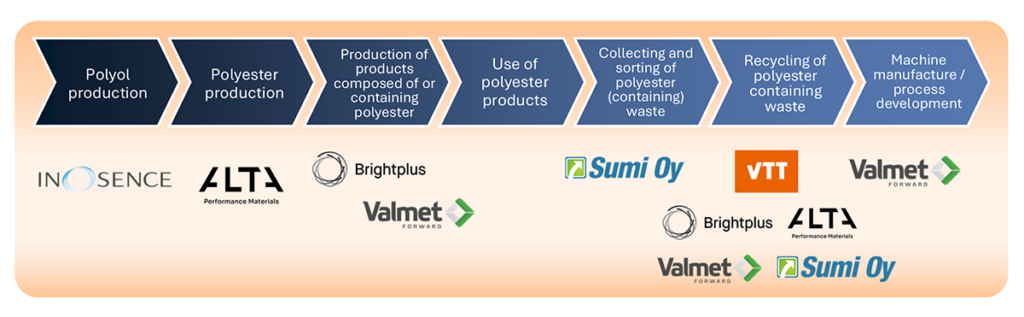
The overall goal is to scale up the recycling process, generate intellectual property, and create an exploitation plan. The project will be linked to the Valmet’s Beyond Circularity Veturi.
Contacts
Project manager and contact person: Principal Scientist Pirjo Heikkilä, pirjo.heikkila@vtt.fi
Questions about the recycling process: Research Professor Ali Harlin, ali.harlin@vtt.fi